

Last week fellow Spellbinder Kimberley Griffiths Little and I travelled to Houston for the Montgomery Book Festival. The day before we left, I had my students write letters to Cynthia Leitich Smith, another author attending the festival.
 During the fall semester the ninth and tenth grade special education English teacher and I collaborated on a project where we had students read Cynthia’s graphic novel, Tantalize. It’s a retelling of her vampire novel by the same name, but from Kieren’s point of view. He’s the hybrid werewolf in love with Quincy, the protagonist of the original story.
Last September we also read a simplified version of Bram Stoker’s Dracula. Students tracked the plot and characters of both books, wrote compare/contrast essays, and created their own hybrid characters and stories. In addition, I brought in a variety of vampire novels including the original Bram Stoker version so that students who finished the first two books would have related material to read in class.
It was an afterthought to ask them to write letters to Cynthia three months after we’d finished her book, but the results were astounding. Both the classroom teacher and I were amazed by how much writing the students produced in two 40 minute sessions. Even our most reluctant writers, those who never finished the story project, all completed a three paragraph letter.
Afterwards, we brainstormed what made the letter project work so well, because we definitely want to do it again. Below are some suggestions if you’d like to try it.
1. Make sure students have read the book. This may seem obvious, but as an author I have often conducted school visits with students who have never read my books. Many authors making the reading of their novels a requirement for attendance. There is a very good reason for this – It’s so much more meaningful to connect with someone whose material you are familiar with and have enjoyed. It’s what makes a two-way conversation possible.
2. Get excited about the books you are asking your students to read. If you can’t get excited about a story, it’s going to be very difficult for the students to get excited. The classroom teacher and I talked about Tantalize with great enthusiasm before we asked students to read it. We discussed Cynthia as an author and shared her other books to encourage students to explore other titles in the series. I told the classes how thrilled I was that I would be seeing Cynthia at the book festival and expressed how delighted I knew she would be at receiving their letters.
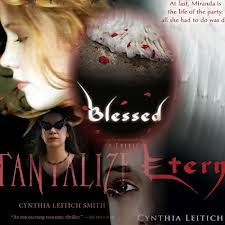
3. Make letter writing a meaningful literacy experience. As educators we realize that writing an essay is a beneficial activity. We have specific goals and benchmarks in mind when creating such assignments. But our students don’t necessarily view this type of writing as valuable. The letters were important to them because they represented true communication with another human being whom they knew would be reading what they wrote for a purpose deeper than checking their punctuation and assigning them a grade.
4. Brainstorm content with the class. Writing letters may address just as many benchmarks and standards as writing essays if the activity is structured with specific goals in mind. I told the students what material I wanted in each paragraph as follows:
Paragraph One: This was the introduction where they told a little bit about themselves and mentioned which book of Cynthia’s they had read.
Paragraph Two: Students were instructed to describe their favorite character or scene from the graphic novel.
Paragraph Three: This was the wrap up and conclusion and students were instructed to end with a question.
During our brainstorm, I asked for examples from the class and wrote them on the board. I then typed the examples so that students who struggled with spelling and structure would have a template to follow.
The next time I assign an author letter, I plan to add a fourth paragraph and ask students to share their favorite quote from the book.
5. Make rewriting a natural part of the process. I brought fancy stationery from home and told the students they needed to write a sloppy copy first so their final draft would be perfect. No one complained about the editing process and one girl even stated that she had completed an additional draft at home.

You don’t have to personally know authors to have your students write letters to them. Many young adult authors may be contacted through online websites or blogs and they love connecting with young readers.
Next month in my column I will share some additional tips for connecting authors and readers including a short review of the book Dear Teen Me, edited by Miranda Kenneally and E. Kristin Anderson (one of my co-panelists at the book festival). It contains letters by various authors to their teen selves and includes an entry by Cynthia Leitich Smith which we will be reading in class next week!


 From the time we started chapter books and then novels, they loved realistic, contemporary fiction, and weren't really interested in most of the genre fiction (sci-fi or fantasy or magic like Harry Potter which frightened them). We enjoyed endless Kate DiCamillo, Sharon Creech, Deborah Wiles, Lynne Rae Perkins, to name a few. But the older they got, the more they wanted their books to have male MC's - characters they could directly relate to in body and mind. And, outside of genre fiction, it got harder and harder to find those relatable male protagonists in contemporary MG and YA. So much was told from a female lead character. So, I decided to write a book for them, narrated by a teen boy. Your average teen boy, who is extraordinary only in the quiet way we are each capable of being.